Rabby Wallet: How transaction simulation reshapes risk management for DeFi power users

Counterintuitively, the single biggest smart-contract risk for advanced DeFi users is not a headline-grabbing exploit but ”blind signing” — approving transactions without a clear, machine-checked preview of what will actually happen to balances and approvals. Rabby Wallet tackles that by shifting a defensive mechanism into the signing flow: before you approve, the wallet simulates the transaction and shows exact token changes and fee estimates. That sounds small, but for traders, liquidity providers, and ops teams who routinely interact with complex contracts across chains, the ability to see the expected outcome before signing can turn a costly mistake into a near-miss.
This article explains how Rabby implements that protection, where it helps (and where it doesn’t), and how to decide whether its trade-offs fit a US-based DeFi power user’s operational profile. Along the way I compare Rabby with two common alternatives — MetaMask and Coinbase Wallet — and give a few practical heuristics you can reuse when evaluating multi-chain wallet choices.
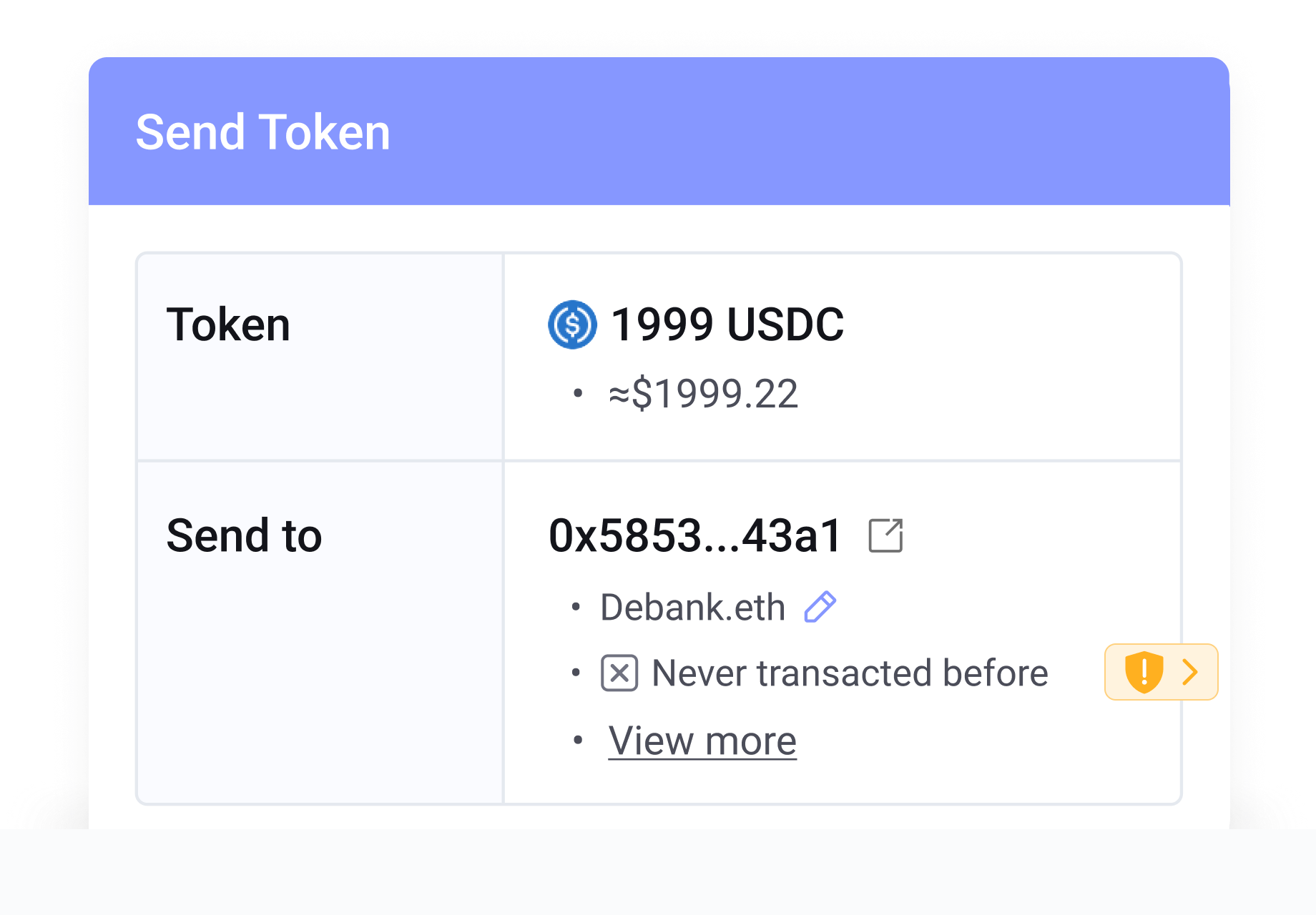
Mechanism: transaction simulation, pre-scan, and automatic network switching
Rabby is a non-custodial, multi-chain wallet built by DeBank and available as a Chromium browser extension, mobile app (iOS/Android), and desktop client for Windows and macOS. Its defensive stack combines three interlocking mechanisms:
1) Transaction simulation: before the user signs, Rabby executes a dry-run of the transaction against a node or local EVM context and calculates precise token movements and gas costs. This converts uncertainty (what will the contract do?) into a concrete preview (here is the expected delta in token balances and fees).
2) Pre-transaction risk scanning: a security engine flags known-bad contracts, suspicious approval patterns, zero-address recipients, or prior exploit history. That scan leverages public incident data and heuristics to highlight suspicious inputs that a raw simulation might not label malicious on its own.
3) Automatic network switching: when you visit a dApp, Rabby detects which EVM-compatible chain the dApp uses and switches networks automatically, reducing human error from transacting on the wrong chain (a frequent source of failed or dangerous calls).
Why these mechanisms matter in practice — and their limits
For DeFi power users, the value of simulation is tactical and practical: it prevents signing a contract that drains a token via an unexpected approve-and-transfer mechanism, reveals multi-step swaps that leave you with dust, and surfaces high fee estimates before you commit. In busy trading windows or when interacting with unfamiliar contracts, those previews materially lower cognitive load and cost risk.
However, simulation is not a magic bullet. It depends on accurate chain state, node behavior, and correct gas estimation. Simulations can be wrong if the node is out of sync, if mempool conditions change between simulation and broadcast, or if the contract behaves differently under real mining conditions (for example, reentrancy that depends on block-time ordering). Rabby’s pre-scan can only flag known suspicious patterns and historically compromised contracts — it cannot prove a contract is safe. In short: simulation reduces asymmetric unknowns but does not eliminate exploitable logic bugs or flash-loan attacks that manifest only at execution time.
Operationally, Rabby lacks a built-in fiat on-ramp and does not provide native staking inside the wallet. For US users who want a single app that buys crypto with ACH or debit and stakes tokens in-wallet, Rabby will need to be paired with an exchange or staking service. That trade-off — narrower focus on on-chain interaction security vs. broader custodial conveniences — is deliberate, but it matters for workflow design.
Comparative trade-offs: Rabby vs. MetaMask vs. Coinbase Wallet
All three are non-custodial EVM wallets, but they differ in emphasis.
– MetaMask: ubiquitous, with a massive developer ecosystem and broad dApp support. It lacks built-in transaction simulation by default (though plugins and analytics tools exist), so power users often add external checks. MetaMask is the interoperability baseline but requires additional tooling for the same pre-sign protection Rabby provides natively.
– Coinbase Wallet: user-friendly, integrates well with the Coinbase fiat/ID ecosystem, and appeals to users who want a smoother fiat bridge. It’s less focused on advanced pre-transaction security primitives, and institutional-grade hardware integrations are less extensive than Rabby’s enterprise integrations.
– Rabby: distinguishes itself with built-in simulation, a revocation tool for token approvals, automatic network switching, and strong hardware-wallet compatibility (Ledger, Trezor, Keystone, and others). For an active trader or ops team that prioritizes on-chain safety, Rabby reduces a class of preventable human errors. The downside: you still need separate services for fiat on-ramps and native staking, and past incidents (the 2022 Rabby Swap exploit) remind us that tooling plus audits reduce but do not eliminate protocol-level risk.
Institutional and multi-sig workflows
Rabby integrates with multi-sig and institutional custody solutions like Gnosis Safe, Fireblocks, Amber, and Cobo Wallet. That means teams can retain Rabby’s simulation and scanning benefits while enforcing multi-signature approval policies. For treasury managers in the US, this hybrid approach is a practical way to combine ops controls with better pre-sign visibility. Still, multi-sig adds latency and human coordination costs; simulate-first workflows help reduce the cognitive overhead of each approval, but they cannot avoid the governance friction of signing chains.
Practical decision heuristics for DeFi power users
Here are three re-usable heuristics to decide if Rabby fits your setup:
1) If you execute complex, batched, or automated transactions across multiple EVM chains, a wallet with pre-transaction simulation meaningfully reduces signing risk. Rabby is designed for this class of user.
2) If you need fiat on-ramps or in-wallet staking as core features, expect to use Rabby alongside custodial services or staking providers. That pairing is common among US users who separate custody/fiat from DeFi execution.
3) If your threat model includes supply-chain or wallet compromise, combine Rabby with hardware wallets and multi-sig; Rabby supports a wide set of hardware devices and integrates with enterprise solutions, which helps operationalize prudent defense-in-depth.
What to watch next
Signals that would change the calculus: native fiat on-ramp integration (would make Rabby more of a one-stop app), broader native staking (would change custody and liquidity trade-offs), or further advances in real-time mempool-aware simulation that account for front-running and MEV dynamics. Also important: continued transparent audits and community-driven reviews of the open-source codebase under the MIT license. Given Rabby’s architecture and past incident responses, improvements in audit frequency and bounty-driven testing are plausible near-term signals to monitor.
FAQ
How does Rabby’s transaction simulation differ from reading contract code?
Simulation executes the transaction against current chain state to show expected balance and fee changes; reading code is manual and error-prone. Simulation captures dynamic behavior (state-dependent branches, token transfers) that static reading can miss, but it won’t reveal hidden vulnerabilities that only appear under adversarial conditions or when external oracle data changes.
Can Rabby prevent all scams and exploits?
No. Rabby’s pre-scan and simulation reduce accidental or careless approvals and flag known malicious patterns, but they cannot prove a contract is safe, stop every on-chain exploit, or prevent losses that occur after signing due to protocol logic bugs or oracle manipulation. Use it as a strong guardrail, not a fail-safe.
Does Rabby work with hardware wallets?
Yes. Rabby supports Ledger, Trezor, Keystone, CoolWallet, GridPlus, BitBox02 and other devices, allowing you to keep private keys offline while still benefiting from transaction simulation and revocation tools.
How do I handle swaps or approvals that look risky in the simulation?
Use Rabby’s revocation tool to cancel approvals, subdivide trades into smaller, test-sized transactions, or route through audited aggregator contracts. For high-value or complex interactions, consider hardware plus multisig and, if possible, conduct a dry-run on a testnet or with a small token amount first.
For readers who want to explore the wallet directly and see its simulation and security checks in action, the project’s informational page is available here: rabby wallet.
In short: Rabby’s simulation-first design is a pragmatic response to a common, underappreciated class of DeFi risk. It does not replace careful protocol due diligence or layered custody, but it converts a diffuse category of human error into concrete, actionable previews — and for many active US-based DeFi users, that conversion is worth adopting into standard operational practice.
Fler nyheter